
 Photo: Huy LuongSave this storySave this story
Some plastic surgeons refer to the earliest phase of facelift recovery as the "alien" stage—and for good reason: Patients tend to look tight, pulled, lumpy, and distorted for days after surgery. Enhancing the extraterrestrial vibe are the two clear, plastic tubes (called drains) sprouting from their heads, through which all manner of blood and ooze exit the face, dripping into suction bulbs that dangle below their ears, storing the gunk. Surgeons typically stitch the open end of the tubes under the skin behind the ears, leaving them in place for up to five days. Need a visual? Behold: Designer Marc Jacobs, drains and all, following his 2021 facelift.
Drains serve an important purpose, clearing the tissues of fluids that could otherwise pool under the skin forming seromas and hematomas (collections of clear fluid and blood, respectively), which can threaten results, delay healing, and prolong recovery. “When we’re doing facelift surgery, or any type of surgery where we’re separating the skin from the deeper tissues, we’re creating what we call a ‘dead space’ that has the potential to collect these fluids,” says T. Gerald O’Daniel, MD, a board-certified plastic surgeon in Louisville, Kentucky. By actively evacuating fluids for several days post-op, drains collapse the space, encouraging any skin that was uprooted during surgery (“skin flaps” in surgeon-speak) to stick back down to the underlying muscle and lay smoothly and evenly, as it should.
In facelift surgery, a hematoma, which usually presents as a painful, bulging purple bruise, is “the most feared complication—the most consequential,” says L. Mike Nayak, MD, a double board-certified facial plastic surgeon in St. Louis, Missouri. It is, in fact, a surgical emergency that can require a return trip to the operating room. “If you get this call in the middle of the night, you don’t sleep on it, because it can be a life-or-death moment,” he notes. In the neck, a large or expanding hematoma can obstruct the airway if it’s not caught early and managed urgently. These kinds of catastrophic hematomas are rare, Dr. Nayak says, “but even minor hematomas create their own misery by dramatically slowing the healing process and making bruising and firmness linger a lot longer.” They can also lead to post-op infections, skin damage, and lumps and bumps. Hematomas occur more frequently in men (due, in part, to the more robust blood supply in their facial skin); other common risk factors include high blood pressure and post-op nausea and vomiting.
A seroma is an area of "soft and smooth swelling," explains Jonathan Cabin, MD, a double board-certified facial plastic surgeon in Washington, D.C. “If you push on it, it feels fluctuant not tense, shifting a bit with compression. But the skin tends to look normal and the sensation is one of mild pressure or heaviness at worst, but usually not frank pain." While less of a 911 scenario than hematomas, seromas are still a “major nuisance,” according to Dr. Nayak, “because they can make the skin drape incorrectly, causing it to wrinkle for many months over the area where the seroma accumulated.” Seromas can also become infectious if the fluid sits for too long, notes Dr. Cabin.
Aiming to prevent such complications, plastic surgeons have long relied on drains, but they’re not without drawbacks. “Patients don’t like drains, because they look weird and scary sticking out of the skin, and they can get caught on things, pull and pinch the skin—they’re just uncomfortable,” Dr. O’Daniel says. (This fact alone makes “drainless” a huge selling point in plastic surgery.) Drains also require tending-to—“stripping” to prevent clogs (pinching and sliding your fingers down the length of the tubes) as well as emptying the bulbs and measuring the output—and have the potential to introduce infection, malfunction, and leave scars and track marks on the skin. What’s more, their removal can be anxiety-provoking: “Patients are always very nervous that it’s going to hurt, but it doesn’t—it’s just a weird sensation,” says Lindsey Pennington, MD, a double board-certified facial plastic surgeon in Shreveport, Louisiana. (She generally removes drains after three to five days, with an accompanying shot of lidocaine, which allows her to painlessly close the wound with a single stitch.) Perhaps the biggest shortcoming of drains is that while they can stop seromas, “they will not save you from hematomas,” says Dr. Nayak. “The blood is just going to start coming out the drains as the face and neck fill up.”
Knowing that they can’t fully prevent hematomas and that they make the recovery process that much more arduous, ditching drains seems like a no-brainer—so why the controversy? Surgeons are creatures of habit, for one. Many learned to use drains as interns in residency and still consider them to be the standard of care. “When you ask them, ‘Why are you using a drain?’ They’ll tell you, ‘That’s the way I was taught,’” explains Sam Rizk, MD, a double board-certified facial plastic surgeon in New York City. It’s a comfort-zone thing—every advance comes with a learning curve—but also: If a surgeon has a low complication rate and attributes it, at least in part, to drains, well, then, if it ain’t broke and all that.
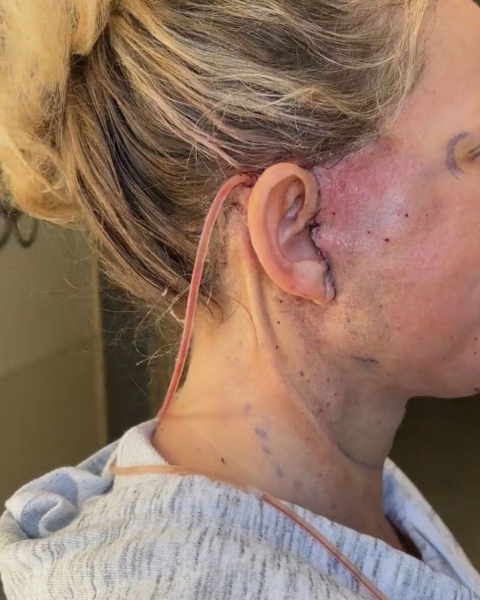
A closer look at a traditional drain.
Courtesy of Dr. L. Mike Nayak
There’s also a fair amount of debate over the safety and efficacy of popular drain alternatives, like fibrin-based tissue glue (an adhesive made from human plasma) and the surgical net (aka hemostatic net), a wild-looking web of temporary sutures that’s stitched through the surface of the skin to quilt together the layers of tissue that were separated during surgery, thereby closing the dead space under the skin to control bleeding and minimize fluid buildup. In addition to thwarting complications, glues and netting can also abate bruising and swelling after facelift surgery, curtailing patients’ recovery. Nevertheless, some surgeons question if these tools truly work as well as drains while others posit that they may cause issues of their own.
The decision to go drainless
With more facelift surgeons educating their followers on drain alternatives, tuned-in patients have begun broaching the topic with their own doctors, says Dr. Pennington. “I have tons of people who DM me on social media or ask during consultation: ‘Do you use drains? Do you use the net?’” And every surgeon has their own take, informed by personal experience and published evidence. No single answer is necessarily right or wrong, Dr. Pennington adds, as each doctor will rely on “whatever yields the best, most consistent results in their hands.”
The type of facelift a surgeon performs—more specifically, the amount of skin that’s lifted off the muscle in each case—may also influence their stance on drains. There are two main categories of facelifts—deep plane and SMAS (an acronym for superficial musculoaponeurotic system)—and various iterations of each. While facelift surgeons quibble over semantics and what truly distinguishes one method from another, ultimately, all modern facelifts adjust the SMAS (muscle layer) in some way. But first, in order to access the SMAS, surgeons have to peel back the overlying skin. How much skin? is the million-dollar question. With some techniques, they’re lifting only a centimeter or two; with others, the separation of skin from muscle is extensive, resulting in larger skin flaps. “The more skin that’s elevated, the greater the risk for hematoma and seroma—and that’s true when using drains, tissue glue, and the surgical net, no matter what,” says Dr. O’Daniel.
The risk increases with the amount of skin that’s lifted, because that leaves a broader area vulnerable to fluid accumulation. During our interview, Dr. Nayak referred to the subcutaneous space directly under the skin as “the trouble layer,” since it’s most prone to bleeding and oozing. (Seromas and hematomas occur less frequently in the deep plane.) “But if you can minimize the amount of surface area at risk,” he says, “that changes the equation.” While Dr. Nayak is famous for his deep plane technique, earlier in his career, he performed a type of SMAS facelift that involved sizable skin flaps. During his SMAS era, he relied on drains, finding them “incomparable” in terms of preventing seromas on large skin flaps. As Dr. Nayak’s technique evolved, his skin flaps shrunk and he abandoned drains in favor of tissue glue and the surgical net. “You don't need a drain for small flaps; you can get away with glue or netting,” he says. But with bigger flaps, “the only thing I’d trust is suction drains to prevent seromas.”
Today, Dr. Nayak specializes in what’s commonly called a preservation-style deep plane face and neck lift, a modification to the extended deep plane, which Allure reported on in 2024. By keeping more skin connected to the deeper tissues—and yielding smaller skin flaps in the face and neck—the technique aims to minimize space for fluid to settle, lessening not only post-op complications, but also bruising, swelling, and trauma to the skin. (Quick caveat: While Dr. Nayak’s facelifts are drainless, he still uses drains for brow lifts. “I use a drain overnight for brow lifts, because the bruising is dramatically different if we pull away the little bits of bloody fluid in that first evening,” he says. “If you have just 12 hours of drain presence, almost nobody bruises.” Without the drain, however, brow lift patients “get a much higher rate and much greater amount of denser, darker, bluer, bigger raccoon eyes,” he says.)
Other surgeons shared similar stories of retiring drains in favor of glues and nets after adopting preservation facelift principles. “I used to use drains on every single facelift patient, and now I use them rarely,” says Dr. Pennington. Dr. Cabin quit using drains a year or two ago when he started routinely performing preservation facelifts. He now uses glue along with the net in every face and neck lift he performs and says “most of my patients prefer that to a drain.”
If you’re having a facelift and hoping to avoid drains, what can you expect from the alternatives? Let’s take a closer look at the options—fibrin glue and the surgical net.
What is tissue glue?
We’re not talking Elmers or Duo. The go-to glue in facelifting contains two components of human blood, fibrinogen and thrombin, which are “the proteins that make your blood sticky,” says Dr. Nayak. (It’s called “Artiss fibrin sealant,” made by Baxter, a manufacturer of surgical products.) When combined during application, “the thrombin enzyme [converts] the fibrinogen into fibrin, which is part of the clotting cascade, and that’s what sticks the flap down and seals it.” The glue slowly hardens, giving surgeons time to position the flap. “You hold pressure for about three minutes to let it settle, and then the skin edges are nicely lined up for suturing,” Dr. Cabin says. “So, the glue also offers a sort of assistant effect, making the closure a bit smoother.”
While tissue glue is currently enjoying its 15 minutes of fame, it’s not new to medicine or plastic surgery. Dr. Rizk first used it over 20 years ago when working as a head and neck surgeon at Memorial Sloan Kettering Cancer Center. “We used glues in graft surgery after taking out cancers,” he tells me. In 2008, Dr. Rizk published a review of 605 drainless facelifts, comparing the incidence of hematomas in patients with and without glue. He found the glue group had a significantly lower rate (.4% versus 3.4% with no glue). Other studies support Dr. Rizk’s findings. An earlier trial comparing drains to glue found fewer hematomas and “significantly less bruising and swelling” in patients who got glue. A 2015 meta-analysis looked at seven controlled trials and found that when fibrin glue was used in facelifts, “hematoma formation was four times less likely.” The authors did not see a significant reduction in seromas, however.
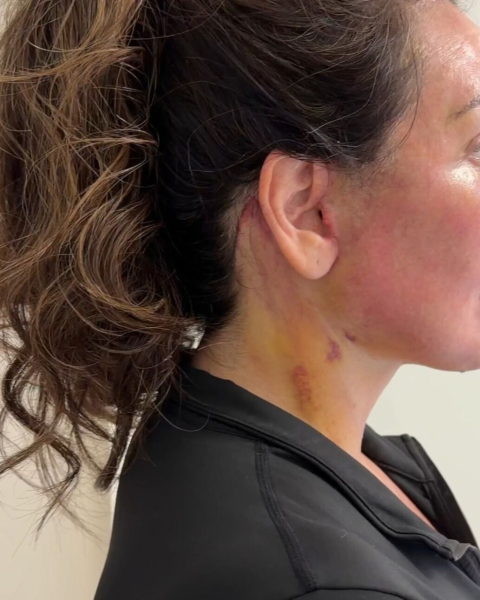
Dr. Nayak used tissue glue on this facelift patient.
Courtesy of Dr. L. Mike Nayak
In practice, proponents of fibrin glue credit the sticky stuff for their low hematoma rates. “I generally have an average of about one to two percent,” says Dr. Rizk. In the medical literature, reported incidence rates range from 0.6% to 14.2%. In Dr. Rizk’s experience, the glue also helps with seromas. Dr. O’Daniel says that in his 20 years of using tissue glue, his hematoma rate held relatively steady at 1.3% to 1.6%. Glue doesn’t eliminate the risk, he notes, but it can diminish it. “It also reduces bruising to an extent,” he says, by sealing the small blood vessels under the skin. Dr. Nayak calls glue “a useful star in the constellation of steps we take to minimize bruising,” adding that it has “a minimal direct effect on swelling,” as well. Likewise, Dr. Cabin believes that glue can improve recovery, but says in his cases, small skin flaps, glue, and the hemostatic net all contribute to better healing, so it’s hard to say which element holds the greatest sway.
On its website, Artiss lists the risks of fibrin glue, among them the possibility of hypersensitivity reactions, including anaphylaxis, and potentially “ transmitting infectious agents,” given that Artiss is made from human plasma procured from donors. Like all FDA-approved biological materials (those sourced from humans, animals, or microorganisms), Artiss is purified and tested to ensure safety and sterility.
Nevertheless, the fact that glue is human-derived “is something that certain patients may find unappealing,” notes Dr. Pennington. Surgeons also point to the price as a potential con. While glue can add up to $1,000 to the procedure, the upcharge seems rather inconsequential given that facelifts can cost between $30,000 and $300,000. Another reservation some shared: If there were a post-op issue that required reoperation, could the glue make it harder to raise the flap, presenting a sticky mess at a critical time? Glue advocates say they haven’t encountered such problems. Besides, notes Dr. Rizk, “after about a week, the glue is gone—the body absorbs it.”
What is the surgical net?
Dr. Pennington recalls the first time she saw the surgical net, its “jarring” image projected onto a vast screen in a lecture hall during a medical meeting. “It looked very Frankenstein-esque,” she says, and seemed to subvert the core tenets of undetectable facial plastic surgery. But the net proved its worth the first time she used it on a male facelift patient who was “super oozy” during surgery. “It worked so much better than a pressure dressing and a drain, which is what we’d been taught [to use] in training,” she says. (A pressure dressing is a snug cotton-gauze wrap worn immediately after surgery.)
The surgical net is formally named the “Auersvald hemostatic net”—hemostatic meaning blood-stopping—after Drs. André and Luiz Auersvald, the plastic surgeons who pioneered the net as a means of curbing their 14% hematoma rate. In a 2014 study, the brothers demonstrated the technique to be a safe and efficient tool for preventing early hematomas after facelifts. According to the seminal paper, the net slashed their hematoma rate to zero.
As a general rule, doctors apply the net only in areas where the skin has been lifted, placing the nonabsorbable sutures about a centimeter apart, and leaving them in place for 48 to 72 hours. It’s worth noting that unlike drains and glue, which can help prevent bruising, the net can sometimes contribute to black-and-blues, Dr. Nayak says, “because we're passing a needle through the skin over and over and over again, and it can bruise while we're doing it.”
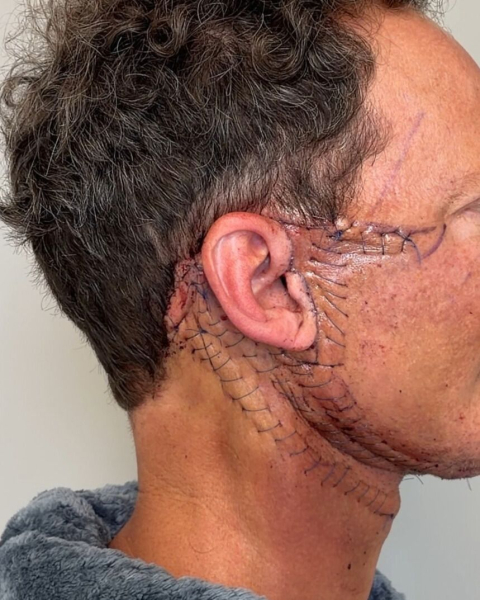
The surgical net, as seen on one of Dr. Nayak’s patients.
Courtesy of Dr. L. Mike Nayak
The net works by “holding the trouble layer tightly shut,” says Dr. Nayak. Its strategically placed sutures divide the tissue into discrete compartments. “If bleeding starts anywhere, it has a hard time propagating and blowing up the whole area, because it can’t pass beyond the little weld points that the hemostatic net sutures create,” he explains. Should a vessel spring a leak, the blood will fill one small segment of the face, exerting pressure until the bleeding stops. “There’s nothing better than the net for bleeding—nothing comes close,” says Dr. Nayak. While “it also does an okay job of preventing seroma,” he still adds glue for good measure.
Dr. O’Daniel started using the net in 2017, initially in conjunction with glue, before transitioning to the net alone a year or so later. “My hematoma rate has gone to zero with the surgical net,” he says. In addition to guarding against complications, the net “speeds recovery for a lot of different reasons,” he explains—a key one being that it “eliminates not only seromas and hematomas, but also the micro fluid collections which cause edema [swelling] and delayed healing.” This is something he observed in a lab-based study using an animal model. His study—which will be released later this year—also showed increased collagen with the net (versus no-net control), suggesting “a faster recovery and normalization of the skin and deeper tissues.”
While the net is widely accepted internationally, says Dr. O’Daniel, it’s only now gaining traction in the United States. “I’m in a group chat with 170 plastic surgeons from around the world—a Who’s Who of thought leaders in facelift surgery—and about 80% of them use the surgical net [routinely] and 100% use it in certain circumstances,” he says. Dr. Nayak, for example, uses the net in patients who are at high risk for developing hematomas—namely, all of his male patients as well as women who bleed excessively during surgery. (Interestingly, a systematic review and meta-analysis from 2025 looked at hematoma rates in more than 8,000 deep plane facelift patients who used tissue glue, a hemostatic net, or another preventative measure, tranexamic acid, and saw similar rates with all three, concluding there is “no clearly superior adjunct.”)
Despite the net’s gruesome appearance, surgeons say that patients are generally fine with it when briefed in advance on the benefits. “I’ve not had a single person freak out,” Dr. Nayak tells me. Dr. O’Daniel says that his repeat facelift patients, who had drains with their first surgery and the net for round two, find the net far more tolerable. Because the face is numb for a time following surgery, patients don’t feel the sutures in their skin, even as they’re being removed.
Still, some surgeons are skeptical. “I’ve never used the hemostatic net,” says Dr. Rizk. “I don’t like the way it looks and it doesn’t make sense to me. I mean, the skin literally looks strangulated.” Champions of the net argue that its safety has been proven in multiple studies showing that it does not restrict blood flow to the skin or promote tissue death.
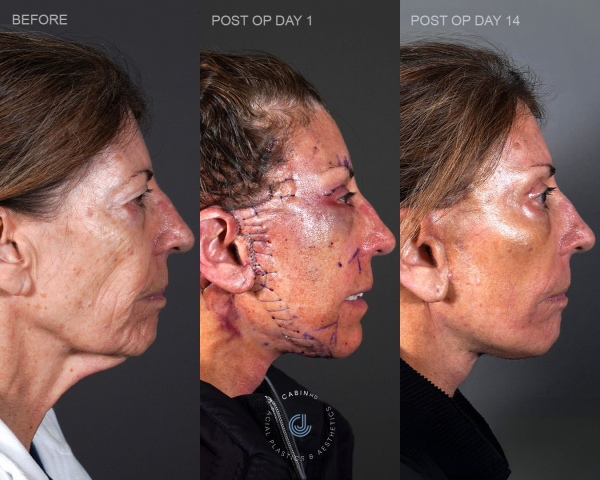
A patient of Dr. Cabin’s before surgery, during recovery using the surgical net method, and two weeks later.
Courtesy of Dr. Jonathan Cabin
Perhaps the biggest concern voiced by patients and doctors is potential scarring from the net, because, well, look at it. It seems almost impossible for such large, looping stitches not to leave a mark. But surgeons say the net doesn’t cause scars or permanent discoloration. In most cases, “people will have little dots or faint lines on their face when we take the stitches out, but a few days later, the skin looks totally normal, like nothing ever happened,” says Dr. Cabin.
On melanated skin (which tends to produce pigment in response to injury and inflammation), marks can take longer to fade, so some surgeons avoid the net in darker-skinned patients. Dr. O’Daniel, who uses the net in all skin types, says that his hyperpigmentation rate is 1.5% to 2% and that any discoloration is temporary. When treated with bleaching creams and lasers, it tends to resolve within three months. A 2025 study looking at net outcomes in Asian patients reported “no persistent hyperpigmentation from the hemostatic net,” noting that 90% of marks subsided within one month. Caucasians with severe sun damage will occasionally develop small white spots where the needle passes through the skin, Dr. O’Daniel adds, but those can be addressed by treating the surrounding sun damage to even things out.
Ultimately, when considering the net, “we're balancing risks,” says Dr. Nayak. “Do we want a potentially life-threatening hematoma or do we want to take the chance that there might be a couple of dots [on the skin] for a few weeks? It's a no-brainer.”
The bottom line? Both tissue glue and the surgical net, used separately or in tandem, can minimize the risk of facelift complications and obviate the need for drains, especially when paired with proven measures to control blood pressure and nausea after surgery. (Drains are still warranted in facelifts with larger skin flaps, however, so you’ll want to talk to your doctor about their surgical approach.) As for how glues and netting affect the healing process? Surgeons’ accounts vary, but all agree that anything that cuts down on complications will make for a swifter, smoother recovery.
Leave a Reply